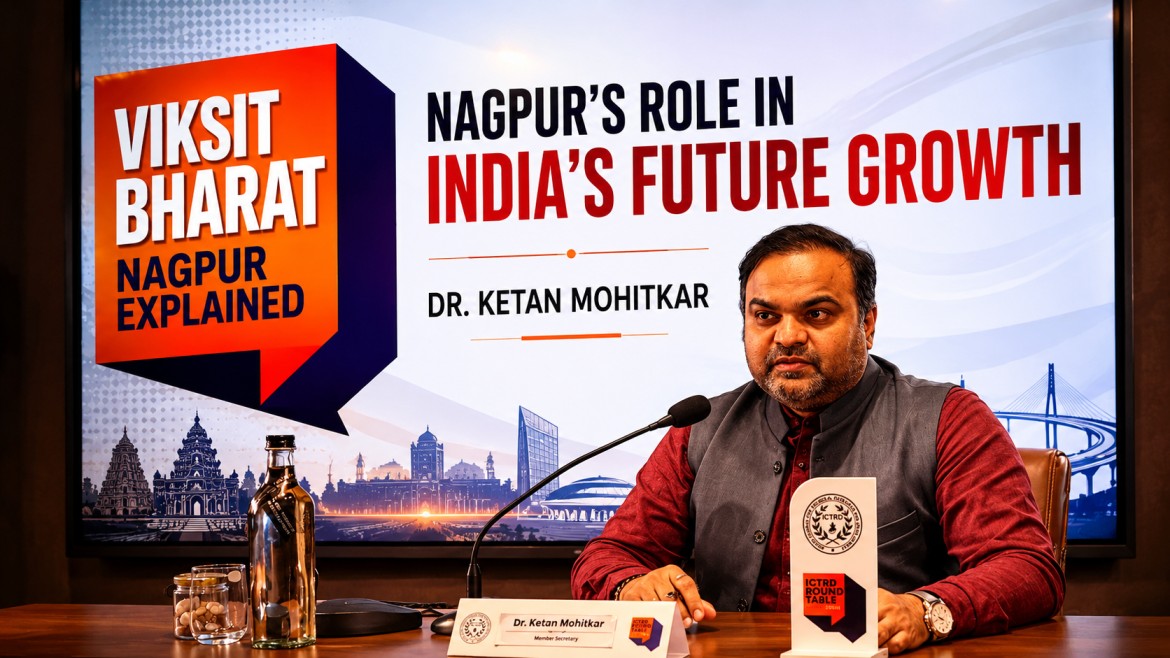
Dr. Ketan Mohitkar
As India moves towards its centenary year of independence in 2047, the national vision of Viksit Bharat 2047 has emerged as one of the most ambitious developmental missions in our history. The objective is not merely to increase GDP or improve infrastructure. It is about transforming India into a nation that is economically prosperous, technologically advanced, socially inclusive, environmentally sustainable, and globally influential.
While much of the discussion around India’s growth has traditionally focused on metropolitan cities, the reality is that the future of India will be shaped by its emerging cities. In this context, Nagpur represents a powerful example of how Tier-II cities can become major contributors to national development.
The Shift from Metro-Centric Growth to Distributed Development
For decades, India’s economic growth was concentrated in a handful of metropolitan regions. Cities such as Mumbai, Delhi, Bengaluru, Chennai, and Hyderabad became magnets for talent, investments, and innovation. While this model generated significant economic growth, it also created regional imbalances.
Today, India is witnessing a structural transformation. The next phase of growth is increasingly being driven by Tier-II and Tier-III cities. According to various economic projections, nearly half of India’s future GDP growth could originate from these emerging urban centres by the mid-2030s.
This transition is critical because a nation of India’s scale cannot become fully developed if opportunities remain concentrated in a few geographical pockets. Development must become decentralized, inclusive, and regionally balanced.
Why Nagpur Matters
Nagpur occupies a unique position in India’s development landscape.
Often referred to as the geographical center of India, Nagpur possesses strategic advantages that few cities can match. Its central location, improving infrastructure, educational institutions, industrial base, and growing entrepreneurial ecosystem create a strong foundation for future growth.
However, geography alone does not create prosperity. Vision, planning, collaboration, and execution do.
The question before us is not whether Nagpur has potential. The real question is whether we can effectively convert that potential into measurable economic and social outcomes.
The Logistics Capital Opportunity
One of Nagpur’s greatest strengths is logistics.
With expanding highway connectivity, rail networks, warehousing infrastructure, and air transport capabilities, Nagpur has the potential to become one of India’s most important logistics and supply chain hubs.
The recent push toward the expansion and modernization of Nagpur Airport further strengthens this opportunity. Enhanced cargo handling capabilities, better international connectivity, and aviation-linked economic activities can significantly improve the city’s attractiveness for investment.
In the coming decades, logistics will not simply support economic growth; it will become a major economic sector in itself. Efficient movement of goods, services, and information will determine the competitiveness of regions and nations.
If developed strategically, Nagpur can emerge as Central India’s logistics gateway and a critical node in India’s economic network.
Building a Knowledge and Innovation Economy
The future economy will be driven not only by manufacturing but also by knowledge, research, and innovation.
Nagpur already hosts universities, research institutions, technical colleges, healthcare institutions, and a growing startup ecosystem. However, these assets often operate independently.
The next stage of development requires ecosystem thinking.
Universities must become innovation centres rather than merely degree-awarding institutions. Research must move beyond academic publications and translate into patents, technologies, startups, and real-world solutions.
Similarly, industry and academia must collaborate more closely to address local and national challenges.
The cities that successfully integrate education, research, entrepreneurship, and industry will become the innovation hubs of tomorrow
Youth: India’s Greatest Strategic Resource
India’s demographic profile presents an unprecedented opportunity.
With one of the world’s largest youth populations, India has the potential to become a global talent powerhouse. However, demographic advantage alone does not guarantee success.
The future belongs to skilled, adaptable, and innovative individuals.
Artificial Intelligence, robotics, cybersecurity, biotechnology, semiconductor manufacturing, clean energy, and advanced digital technologies are rapidly transforming global economies.
Educational institutions and skill development initiatives must prepare young people not only for today’s jobs but also for tomorrow’s opportunities.
Nagpur can become a major talent development hub by creating stronger linkages between education, industry requirements, entrepreneurship, and emerging technologies.
Startups and Entrepreneurship as Engines of Growth
One of the most encouraging developments in recent years has been the rise of startup activity beyond metropolitan cities.
Innovation is no longer confined to major urban centres. Entrepreneurs from smaller cities are solving local problems with scalable solutions.
However, innovation requires more than ideas.
Successful startup ecosystems depend on mentorship, funding, incubation support, policy assistance, networking opportunities, and market access.
Cities that encourage risk-taking, experimentation, and innovation will attract talent and investments.
Nagpur has already witnessed significant growth in entrepreneurial activity. With the right support systems, it can become a leading startup destination in Central India.
Sustainable Development Must Remain Central
Economic growth without sustainability creates long-term challenges.
As cities expand, issues related to water management, waste disposal, environmental conservation, energy efficiency, and urban mobility become increasingly important.
Nagpur has an opportunity to become a model city for sustainable urban development.
Investments in renewable energy, water conservation, green infrastructure, public transportation, and smart urban planning can help ensure that growth remains environmentally responsible.
A truly developed city is not only economically successful but also livable, resilient, and sustainable.
The Importance of Collaborative Leadership
No single institution can achieve transformational change alone.
The journey toward Viksit Bharat requires collaboration among governments, educational institutions, industries, research organizations, startups, civil society, and citizens.
Platforms that bring together diverse stakeholders are essential for creating actionable solutions and shared visions.
This is precisely why dialogues, roundtables, policy discussions, innovation forums, and collaborative initiatives are increasingly important. They help bridge gaps, align priorities, and convert ideas into collective action.
A Vision for Nagpur 2047
As we look toward 2047, we should aspire to position Nagpur as:
- A leading logistics and supply chain hub
- A centre for innovation and startups
- A knowledge and research-driven city
- A healthcare and medical technology destination
- A sustainable urban development model
- A talent and skill development powerhouse
- A globally connected economic growth engine
Achieving this vision will require long-term thinking, policy continuity, investment in human capital, institutional collaboration, and active citizen participation.
The story of Viksit Bharat will not be written solely in India’s metropolitan cities. It will be shaped by emerging cities that embrace innovation, develop talent, encourage entrepreneurship, and create sustainable growth models.
Nagpur possesses many of the ingredients necessary to become one of these transformational cities.
The challenge before us is to move from potential to performance, from discussion to execution, and from aspiration to achievement.
If we succeed, Nagpur will not merely participate in India’s journey toward becoming a developed nation—it will help lead it.
The road to Viksit Bharat 2047 runs through India’s emerging cities. Nagpur has every opportunity to be one of the most important milestones on that journey.
.webp)